

Middle School Resource Hub
Middle school is a season of big questions, strong feelings, and important decisions. Our hope is to walk with students through Scripture and point them to Jesus in a way that feels real and grounded in everyday life.
This hub is here to help equip you as a parent or guardian. Each week we will study the Bible together, explore how it connects to life in Saint Pete, and invite students to follow Jesus in their homes, schools, and friendships. Here you will find simple tools to help you keep the conversation going at home.
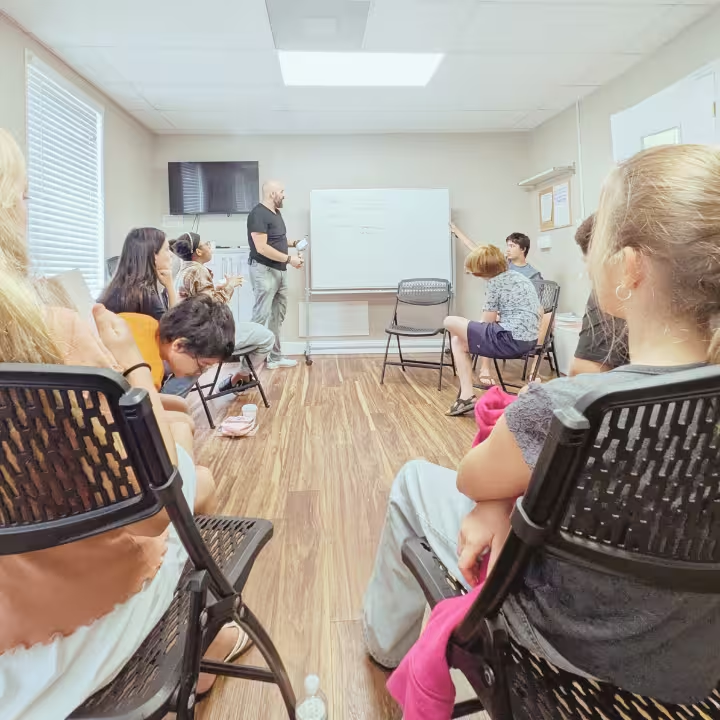
Family Guides
Each Sunday our middle school group focuses on a specific theme from Scripture. For every week we create a short parent summary to help you know what your student is learning and how you can build on it at home.
• A simple overview of the teaching
• Questions you can ask your student
• Practical ideas to live out the lesson together
Use these guides at the dinner table, on the way to school, or anytime you want to draw your family back to Jesus and his story.
October Family Guide
The Gospel Story: Jesus Is King
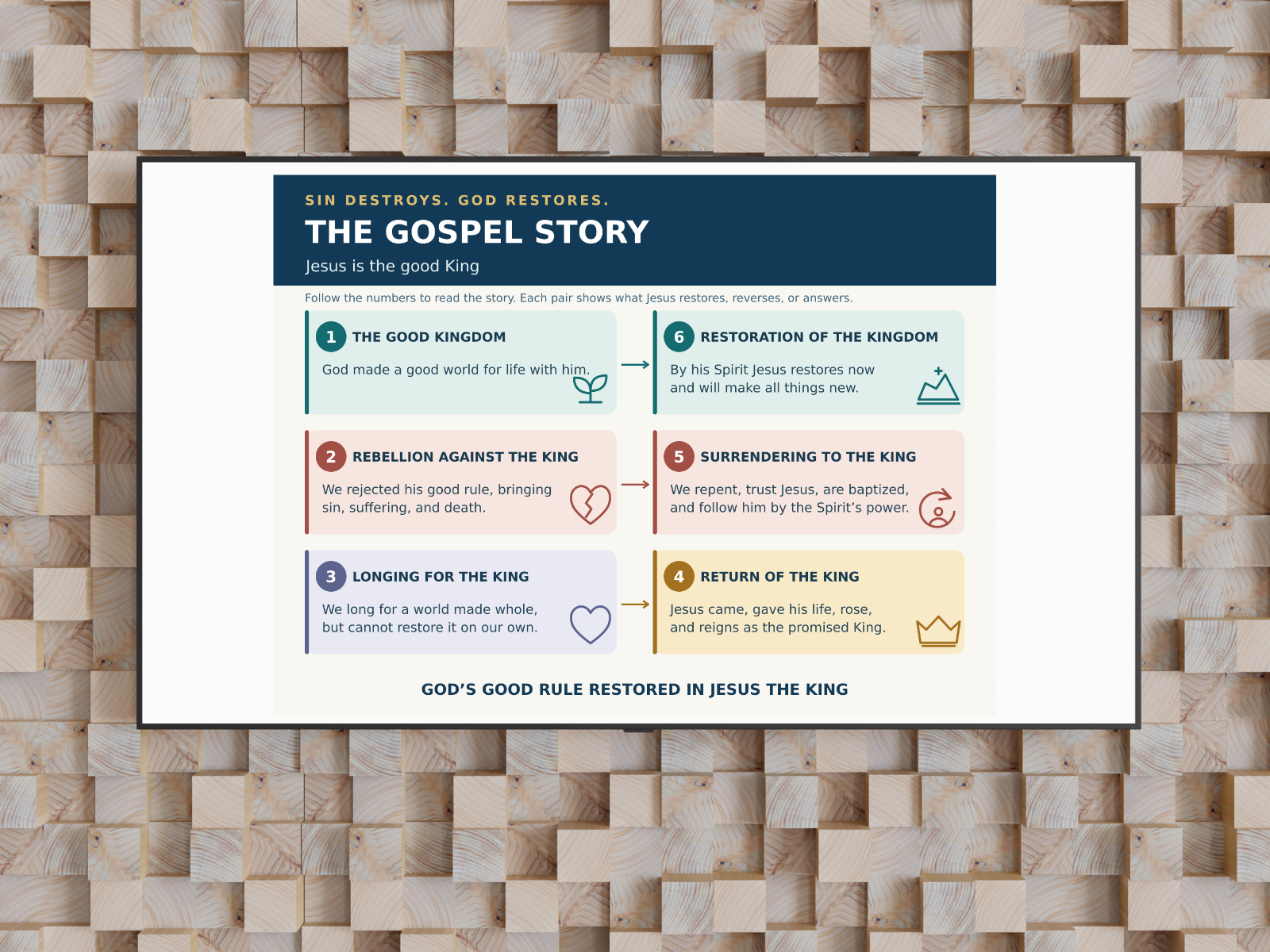
Our middle schoolers are exploring the gospel as the announcement that God’s good rule is being restored through Jesus the King. God made a good world and created people to live with him and reflect his goodness. Humans rejected his rule, and the world we know bears the effects of that rebellion. Yet God did not abandon his creation. He sent Jesus, the promised King, to forgive sins, defeat death, and begin making things right.
We are learning this story through six connected ideas:
- The Good Kingdom: God created a good world and made humans to represent him.
- Rebellion Against the King: Humans chose their own way instead of trusting God’s good rule.
- Longing for the King: We long for the peace and wholeness we cannot restore on our own.
- Return of the King: Jesus came as the promised King. Through his life, death, resurrection, and reign, God’s kingdom has come near.
- Surrendering to the King: Jesus invites us to repent, trust him, be baptized, and follow him.
- Restoration of the Kingdom: Jesus continues his work through his Spirit and his people. One day he will make all things new.
In class, students arranged these ideas on the whiteboard and noticed how they connect. Restoration answers what was lost from the good kingdom. Surrender is our response to rebellion. Jesus answers our longing for the King.
A month of conversations at home
You do not need to teach a lesson each week. Read a passage together, ask one or two questions, and make room for your child’s own observations and questions.
Week 1: What was God’s good kingdom like?
Read Genesis 1:26–28 and Genesis 3:1–7.
- What did God make humans to do?
- What did the first humans believe about God when they chose their own way?
- Where do you see both goodness and brokenness in the world around you?
Week 2: What kind of king do we need?
Read Isaiah 9:6–7 and Mark 1:14–15.
- What do these passages lead you to expect from God’s promised King?
- What does Jesus announce?
- How does Jesus show us that God’s rule is good?
You could watch BibleProject’s The Messiah or Gospel of the Kingdom together and ask what stood out to your child.
Week 3: What does it mean to follow King Jesus?
Read Mark 1:14–15 and Acts 2:36–39.
- What do repentance and faith mean?
- Where is it difficult to trust that Jesus’ way is good?
- What questions do you have about following Jesus or baptism?
Listen with curiosity. These questions are an invitation to talk, not a test your child needs to pass.
Week 4: What is Jesus restoring?
Read Matthew 28:18–20 and Revelation 21:1–5.
- What is Jesus asking his followers to do now?
- How could our family show his compassion to someone this week?
- What are you looking forward to when Jesus makes everything new?
BibleProject’s Heaven and Earth can help your family picture the hope of God dwelling with his people and renewing creation.
The question we hope students keep asking is simple: If Jesus is the good King, what does it look like to trust and follow him today?
July-August Parent Guide [Your Story in God’s Story]
Middle School Parent Equipping Guide
Your Story in God's Story + WhoWhatWhoWhat
Helping Students Read the Bible for Themselves
One of our biggest goals in middle school is not simply to teach students about the Bible. We want to teach them how to read the Bible well so that, over time, they become confident followers of Jesus who can understand Scripture, encourage others, and one day even teach God's Word themselves.
Jesus didn't simply gather people to listen. He formed disciples who would eventually make disciples. We want to help our students begin that journey now.
Learning to Read the Bible
Over the past several weeks, we've been introducing a simple framework that students can use with almost any passage of Scripture.
Before We Begin
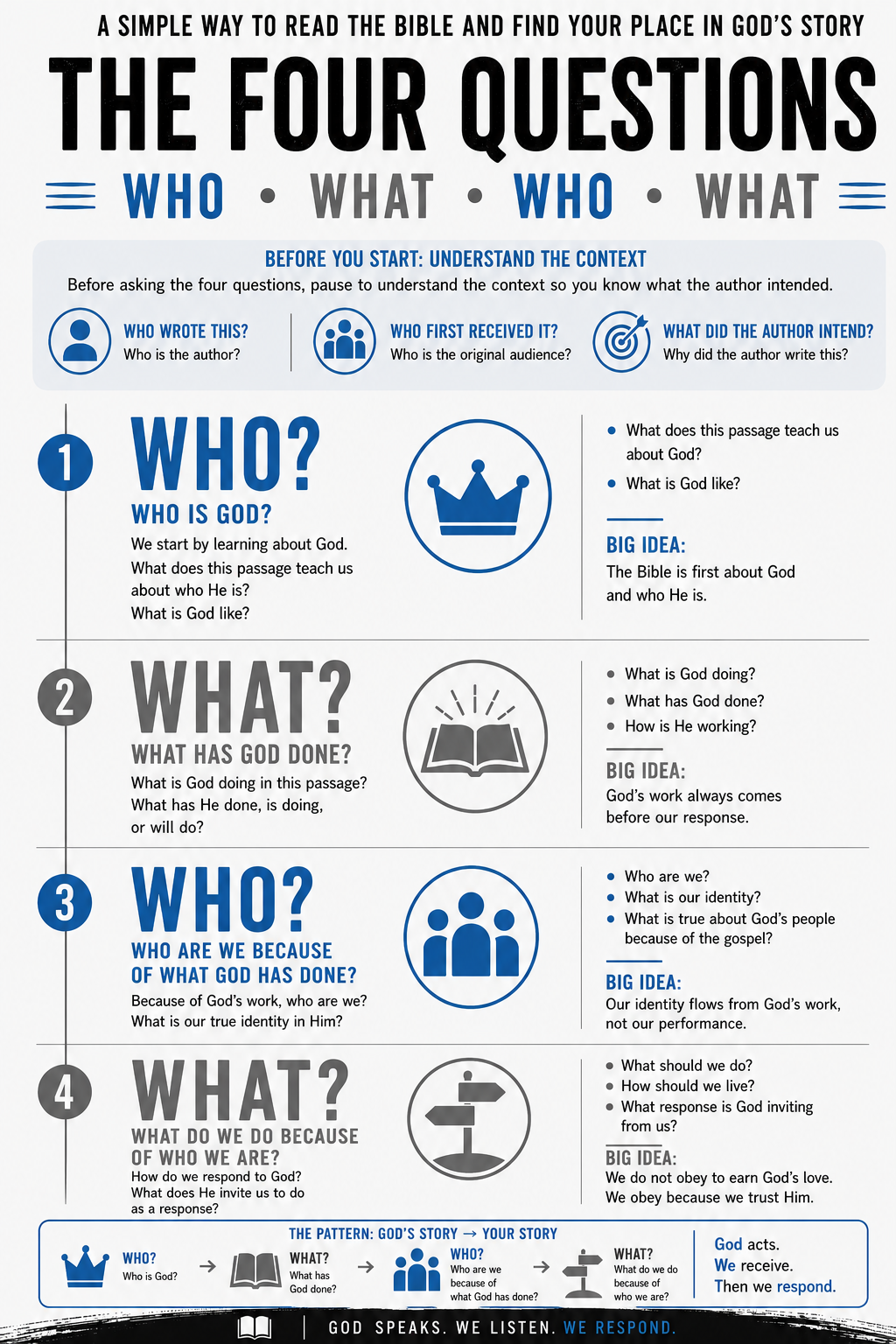
Before asking what a passage means, we first slow down and understand its context by asking:
- Who wrote this?
- Who first received it?
- When was it written?
- Where does this fit in the story of the Bible?
- Why did the author write it?
These questions help students understand what the biblical author intended to communicate before jumping straight to personal application.
Once we understand the context, we begin asking The Four Questions.
1. Who is God?
The Bible is first about God.
Students learn to ask:
- What does this passage teach me about God?
- What is He like?
2. What has God done?
Next, students look for God's work.
They ask:
- What is God doing?
- What has He done?
- What is He accomplishing?
3. Who are we because of what God has done?
Instead of creating our own identity, we discover the identity God gives His people through Jesus.
Students ask:
- Who are we?
- What is true about God's people?
4. What do we do because of who we are?
Only after understanding who God is, what He has done, and who we are do we ask:
- How should we respond?
- How does God invite us to live?
One phrase we've been repeating together is:
God acts. We receive. Then we respond.
This helps students remember that obedience is not about earning God's love.
We do not obey to earn God's love. We obey because we trust Him.
What We Worked Through This Week
This past Sunday, we practiced this process together by studying Ephesians 1:1 through 10.
Rather than simply listening to someone explain the passage, students opened their own Bibles, read the text together, and helped build our notes on the whiteboard.
Together we discovered things like:
Who is God?
Paul describes God as:
- Our Father
- The Father of our Lord Jesus Christ
- Loving
- Purposeful
- Wise
What has God done?
Students found that God:
- Gives grace and peace.
- Blesses His people with every spiritual blessing.
- Chose His people before the creation of the world.
- Loves His people.
- Adopts His people through Jesus.
- Redeems and forgives through Christ.
- Is carrying out His plan to unite everything under King Jesus.
Who are we?
The class discovered that believers are:
- God's holy people
- Faithful
- Blessed
- Blameless
- Children of God
- Members of His family
What do we do?
One of the clearest responses Paul gives is simple:
Praise God.
The students did an excellent job searching the text and contributing their own observations throughout the discussion. We only scratched the surface and will continue. It takes time to allow them to process and discuss. We don’t want to move too fast and turn them into spectators...we want participants...and they are doing a great job engaging!
Why We Teach This Way
One of our biggest goals is participation.
Students are encouraged to:
- Bring and read from their own Bible.
- Practice finding passages.
- Search the text for answers instead of waiting to be told.
- Share their observations with one another.
Research consistently shows that we retain information much more deeply when we have to explain it to someone else. That is why we are gradually helping students move from simply listening to eventually teaching.
Our hope is that every student will eventually be able to open a passage of Scripture, work through these questions, and confidently explain what they have learned to someone else.
One day, we'd love for each student to teach the class through a passage using this same framework.
Books of the Bible Challenge
We're also continuing our Books of the Bible Challenge!
The first student to memorize all 66 books of the Bible earned $20 cash!
Knowing the books of the Bible helps students become much more confident when navigating Scripture and finding passages during class.
One fun way we've recommended practicing is by learning the Bible Rap, which can be found here:
How You Can Help at Home
You don't need to be a Bible expert to reinforce what we're learning. Even ten minutes together can make a lasting impact.
Here are a few simple ways to encourage your student during the week:
- Ask them to teach you what they learned on Sunday. If they can explain it, they're beginning to truly understand it.
- Read a short section of Scripture together and let your student lead the discussion using the Four Questions.
- Encourage them to practice finding books of the Bible without using the table of contents.
- Watch the Bible Rap together and see if they can teach you a few books each week.
- Celebrate their curiosity. When they ask questions about Scripture, remind them that good questions are part of learning to follow Jesus.
Our prayer is that these students don't simply leave middle school knowing more Bible facts. We hope they leave knowing how to open God's Word with confidence, understand what He is saying, trust Him more deeply, and eventually help others do the same.
June Parent Guide [Your Story in God’s Story]

Middle School Parent Equipping Guide
Your Story in God's Story
Over the past two weeks, our middle school students have been exploring the big story of the Bible and discovering how their own stories fit within God's story.
One of our goals is helping students understand that the Bible is not just a collection of disconnected stories. It is one unified story that leads to Jesus and invites us to participate in what God is doing in the world.
We have been using six words to summarize the storyline of Scripture:
Creation
God created the world good and created humans to be His image bearers.
Rebellion
Humanity rejected God's wisdom and believed lies, bringing sin, suffering, and brokenness into the world.
Promise
God promised to send a King who would rescue His people and restore creation. The Meassiah, the Christ, God’s good promised king.
Jesus
Jesus is the fulfillment of God's promises. Through His life, death, and resurrection, He forgives sins and defeats the powers of sin and death.
Power
God gives His Spirit to His people so they can follow Jesus and participate in His mission.
Renewal
Jesus is making all things new, and one day He will fully restore creation.
The Big Idea
We have also been talking about how this is not only God's story.
It is your story in God's story.
Every person is searching for answers to questions like:
- Why am I here?
- Why is the world broken?
- What will fix it?
- What should I hope for?
- What kind of person should I become?
The Bible gives God's answers to those questions.
We discussed how people often experience pain, loneliness, disappointment, fear, or suffering and then look for relief through false promises.
Some people believe:
- Popularity will make me happy.
- Success will make me valuable.
- Money will make me secure.
- Being accepted by everyone will make me complete.
- Having power or control will solve my problems.
The Bible teaches that these promises ultimately cannot heal our deepest needs.
Only Jesus can truly restore our relationship with God and show us who we were created to be.
Family Discussion Questions
Choose one or two questions during a meal, in the car, or before bed.
Creation
- Why do you think God created people?
- What does it mean to be made in God's image?
- What gifts or abilities has God given you that can reflect His character?
Rebellion
- What are some lies people are tempted to believe today?
- Why do you think people sometimes choose their own way instead of God's way?
- How does sin affect our relationships with God and others?
Promise
- What are some things people hope will make them happy?
- Which promises from God encourage you most right now?
- Why do you think God spent so much of the Bible preparing people for Jesus?
Jesus
- What makes Jesus different from every other person in history?
- How does Jesus help us when we experience pain or suffering?
- What is one thing Jesus teaches that you find challenging?
Power
- What do you think it means that God's Spirit lives in His people?
- How can God's Spirit help us follow Jesus this week?
- Where do you need God's help right now?
Renewal
- What do you think God's renewed world will be like?
- If you could remove one broken thing from the world, what would it be?
- How can we participate in God's work of renewal today?
Family Activity: Tell Your Story
As a family, take turns walking through these six words:
Creation → Rebellion → Promise → Jesus → Power → Renewal
Ask:
- How have you experienced God's goodness?
- How have you experienced brokenness or suffering?
- What false promises have tempted you?
- How has Jesus met you in those struggles?
- How is God changing you today?
- What are you hoping God will renew in your life?
This activity helps students see that the Bible is not just information to learn. It is the story they are invited to live.
Bible Books Challenge
We are continuing our challenge to memorize all 66 books of the Bible!
One resource we showed the students is:
Can You Memorize The Bible Rap? With this Bible Rap, you too can remember all 66 books of the Bible!
https://www.youtube.com/watch?v=49ZR2XthI7s
Consider playing it in the car, during breakfast, or a few times throughout the week. You may be surprised how quickly the books of the Bible start to stick.
This Week's Encouragement
One of the most important things your child can learn is that their life is not random.
They were created by God, loved by God, and invited into God's story.
As you talk together this week, remind them that the goal is not simply to know the Bible's story. The goal is to know Jesus and discover how their story finds its meaning in Him.
"For from him and through him and to him are all things. To him be glory forever. Amen."
Romans 11:36
05.03.26 and 5.24.26 The Story of God, the Trinity, and Our Role
Middle School Parent Guide
God’s Story, The Resurrection, and Where We Fit
What We Covered (Last 2 Weeks)
We walked students through the entire story of the Bible using this framework:
Creation → Rebellion → Promise → Jesus → Power → Renewal
Here is how we explained it:
Creation
God made a good world where people lived with Him
Rebellion
Humans chose their own way, bringing sin, death, and brokenness
Promise (Israel)
God chose a people and promised to rescue and restore everything
Jesus
Jesus came as the fulfillment of that promise
He lived, died, and rose again
Power (Church)
The Holy Spirit empowers God’s people to live as a preview of His Kingdom
Renewal
Jesus is making all things new now, on earth as it is in heaven
And one day, He will complete that renewal fully
The Big Idea
The resurrection is the turning point of the whole story.
It means God’s renewal has already started, and we are invited into it.
Why the Resurrection Matters
For the World
God is not abandoning creation
Evil and death do not get the final word
Renewal has already begun through Jesus
For Your Student
- They are not stuck in sin, shame, or failure
- They can know Jesus and walk with Him now
- Their life has purpose in God’s story
What Makes the Resurrection Unique
Help your student see this clearly:
Jesus did not just teach truth, He rose from the dead in history
The resurrection is physical and real
God is restoring this world, not replacing it
Read Together (Keep It Simple)
Pick 1 or 2 this week:
Genesis 1:31
Genesis 3:6–7
Luke 24:5–7
John 20:19–20
Acts 1:8
Revelation 21:3–5
Family Discussion (5–10 Minutes)
You do not need to get through all of these. Pick one.
- Which part of the story stands out to you and why
- Why does the resurrection matter
- Where do you see brokenness in your school or friendships
- What might it look like for God to bring renewal there
- What do you think your role is in God’s story
Forming Your Student This Week
1. One Simple Weekly Habit
Do this once this week. Keep it low pressure.
“Notice and Join”
Ask: What is something broken or not right around you?
Listen without correcting
Ask: What would it look like for Jesus to bring renewal there?
Pray one short prayer together
Encourage one small action
Examples:
- Include someone left out
- Forgive someone
- Speak encouragement
- Help someone in need
Goal: Help your student see they are not just observing the world, they are joining what Jesus is doing.
2. One Sentence to Repeat Daily
Say this at breakfast, in the car, or before bed:
“Jesus is making all things new, and we get to be part of it.”
Let it shape how they see their day.
3. A 3 Minute Bedtime Liturgy
This is where formation really happens. Keep it simple and repeatable.
Step 1: Look Back (1 minute)
Ask:
- What was good today
- What felt broken or hard
Step 2: Name It (1 minute)
Help them say:
- Thank you for the good
- This is where things were not right
Step 3: Join Jesus (1 minute)
Pray something like:
“Jesus, thank you that you are making all things new.
Help us trust you.
Show us how to bring your love into what is broken.
Make us part of your renewal. Amen.”
A Simple Way to Say It
Come back to this often:
“Jesus rose from the dead, so God is making everything new right now, and one day He will make it completely new.”
Parent Tip (Be Honest)
If I push you a little here:
The biggest mistake is trying to teach more content.
What your student actually needs is:
- repetition
- simple practices
- a parent who is learning alongside them
You do not need to have all the answers.
You just need to step into the story with them.
03.29.26 and 4.05.26 God’s Story and How We Fit In
Middle School Parent Guide
God’s Story, The Resurrection, and Where We Fit
What We Covered (Last 2 Weeks)
We walked students through the entire story of the Bible using this framework:
Creation → Rebellion → Promise → Jesus → Power → Renewal
Here is how we explained it:
Creation
God made a good world where people lived with Him
Rebellion
Humans chose their own way, bringing sin, death, and brokenness
Promise (Israel)
God chose a people and promised to rescue and restore everything
Jesus
Jesus came as the fulfillment of that promise
He lived, died, and rose again
Power (Church)
The Holy Spirit empowers God’s people to live as a preview of His Kingdom
Renewal
Jesus is making all things new now, on earth as it is in heaven
And one day, He will complete that renewal fully
The Big Idea
The resurrection is the turning point of the whole story.
It means God’s renewal has already started, and we are invited into it.
Why the Resurrection Matters
For the World
God is not abandoning creation
Evil and death do not get the final word
Renewal has already begun through Jesus
For Your Student
- They are not stuck in sin, shame, or failure
- They can know Jesus and walk with Him now
- Their life has purpose in God’s story
What Makes the Resurrection Unique
Help your student see this clearly:
Jesus did not just teach truth, He rose from the dead in history
The resurrection is physical and real
God is restoring this world, not replacing it
Read Together (Keep It Simple)
Pick 1 or 2 this week:
Genesis 1:31
Genesis 3:6–7
Luke 24:5–7
John 20:19–20
Acts 1:8
Revelation 21:3–5
Family Discussion (5–10 Minutes)
You do not need to get through all of these. Pick one.
- Which part of the story stands out to you and why
- Why does the resurrection matter
- Where do you see brokenness in your school or friendships
- What might it look like for God to bring renewal there
- What do you think your role is in God’s story
Forming Your Student This Week
1. One Simple Weekly Habit
Do this once this week. Keep it low pressure.
“Notice and Join”
Ask: What is something broken or not right around you?
Listen without correcting
Ask: What would it look like for Jesus to bring renewal there?
Pray one short prayer together
Encourage one small action
Examples:
- Include someone left out
- Forgive someone
- Speak encouragement
- Help someone in need
Goal: Help your student see they are not just observing the world, they are joining what Jesus is doing.
2. One Sentence to Repeat Daily
Say this at breakfast, in the car, or before bed:
“Jesus is making all things new, and we get to be part of it.”
Let it shape how they see their day.
3. A 3 Minute Bedtime Liturgy
This is where formation really happens. Keep it simple and repeatable.
Step 1: Look Back (1 minute)
Ask:
- What was good today
- What felt broken or hard
Step 2: Name It (1 minute)
Help them say:
- Thank you for the good
- This is where things were not right
Step 3: Join Jesus (1 minute)
Pray something like:
“Jesus, thank you that you are making all things new.
Help us trust you.
Show us how to bring your love into what is broken.
Make us part of your renewal. Amen.”
A Simple Way to Say It
Come back to this often:
“Jesus rose from the dead, so God is making everything new right now, and one day He will make it completely new.”
Parent Tip (Be Honest)
If I push you a little here:
The biggest mistake is trying to teach more content.
What your student actually needs is:
- repetition
- simple practices
- a parent who is learning alongside them
You do not need to have all the answers.
You just need to step into the story with them.
03.15.26 Eden, Temple, Holy Spirit, God’s People

Parent Follow Up Guide
Temple | God With His People
This week, we taught students a big Bible theme:
The temple is about God dwelling with his people.
We helped them see that the temple is not just a building in the Old Testament. The whole story of Scripture moves like this:
Creation
God made the world to be the place where he dwells with people.
Eden
The garden was like a holy place where humanity lived with God.
Tabernacle and Temple
After sin and exile, God gave Israel sacred spaces that pointed back to Eden and forward to something greater.
Jesus
Jesus is the true temple, the place where heaven and earth meet.
The Church
Through the Holy Spirit, God now dwells in his people.
New Creation
One day, all things will be made new, and God will dwell with his people forever.
Main idea for your family
Help your child remember this sentence:
God wants to dwell with his people, and Jesus makes that possible.
A simple way to talk about it:
You do not need to explain every detail from class. Aim for clarity, not complexity.
You could say:
“In the Bible, the temple showed that God wanted to be near his people. But the biggest surprise is that Jesus became the true temple. Now, through Jesus and the Holy Spirit, God lives with his people, and one day he will make all creation his dwelling place again.”
Read together this week:
Choose one or two of these passages to read as a family.
Genesis 1:26 to 31
God makes people in his image.
Genesis 2:8 to 15
God places humanity in the garden.
John 2:19 to 21
Jesus says his body is the temple.
Ephesians 2:19 to 22
God’s people are being built into his dwelling place.
Revelation 21:1 to 5, 22
In the end, God dwells with his people forever.
Questions to ask your child
Keep it natural. You do not need to ask all of them.
1. What do you remember most from this week’s lesson about the temple?
2. Why do you think God gave Israel the tabernacle and temple?
3. What surprised you about Jesus being the true temple?
4. What does it mean that God’s presence is not limited to one building now?
5. How should our lives change if God dwells in his people by the Holy Spirit?
6. How does this theme help us understand who Jesus really is?
One important connection to make
Your middle schooler may think “temple” is mostly about a religious building.
Help them see this:
The temple theme is really about presence, relationship, holiness, and mission.
God does not just want people to know facts about him.
He wants people to live with him, be changed by him, and reflect him in the world.
A simple family activity
Try this short object lesson.
Take a flashlight or lamp and place it in a dark room.
Ask:
What changes when light enters a dark place?
Then say:
“God’s presence brings life, order, beauty, and peace. In the Bible, the temple was about God bringing his presence into the world. Jesus is the true light and the true temple. When we trust him, his presence changes us too.”
Then ask:
Where do you think our family needs more of Jesus’ light right now?
A challenge for the week
Encourage your child to practice one of these:
Notice God’s presence
Take one minute each day to be still and pray, “Jesus, help me be aware that you are with me.”
Reflect God’s presence
Choose one act of peace, kindness, or service this week as a way of showing what God is like.
Remember who we are
When your child feels alone, anxious, or unseen, remind them:
In Jesus, God has not moved away from us. He has moved toward us.
A prayer you can pray together
Jesus, thank you that you are the true temple, the place where heaven and earth meet. Thank you that through your death and resurrection, we can be near to God. Fill our home with your presence. Shape us to be people of peace, holiness, love, and joy. Help us live like people who belong to you. Amen.
Parent encouragement
Some of this theme is big and deep, and that is okay. Your goal this week is not to cover everything. Your goal is to help your child walk away with this truth:
God wants to be with his people, and Jesus is the way.
03.08.26 Eden, Temple, Holy Spirit, God’s People
Parent Follow Up Guide
Temple | God With His People
This week, we taught students a big Bible theme:
The temple is about God dwelling with his people.
We helped them see that the temple is not just a building in the Old Testament. The whole story of Scripture moves like this:
Creation
God made the world to be the place where he dwells with people.
Eden
The garden was like a holy place where humanity lived with God.
Tabernacle and Temple
After sin and exile, God gave Israel sacred spaces that pointed back to Eden and forward to something greater.
Jesus
Jesus is the true temple, the place where heaven and earth meet.
The Church
Through the Holy Spirit, God now dwells in his people.
New Creation
One day, all things will be made new, and God will dwell with his people forever.
Main idea for your family
Help your child remember this sentence:
God wants to dwell with his people, and Jesus makes that possible.
A simple way to talk about it:
You do not need to explain every detail from class. Aim for clarity, not complexity.
You could say:
“In the Bible, the temple showed that God wanted to be near his people. But the biggest surprise is that Jesus became the true temple. Now, through Jesus and the Holy Spirit, God lives with his people, and one day he will make all creation his dwelling place again.”
Read together this week:
Choose one or two of these passages to read as a family.
Genesis 1:26 to 31
God makes people in his image.
Genesis 2:8 to 15
God places humanity in the garden.
John 2:19 to 21
Jesus says his body is the temple.
Ephesians 2:19 to 22
God’s people are being built into his dwelling place.
Revelation 21:1 to 5, 22
In the end, God dwells with his people forever.
Questions to ask your child
Keep it natural. You do not need to ask all of them.
1. What do you remember most from this week’s lesson about the temple?
2. Why do you think God gave Israel the tabernacle and temple?
3. What surprised you about Jesus being the true temple?
4. What does it mean that God’s presence is not limited to one building now?
5. How should our lives change if God dwells in his people by the Holy Spirit?
6. How does this theme help us understand who Jesus really is?
One important connection to make
Your middle schooler may think “temple” is mostly about a religious building.
Help them see this:
The temple theme is really about presence, relationship, holiness, and mission.
God does not just want people to know facts about him.
He wants people to live with him, be changed by him, and reflect him in the world.
A simple family activity
Try this short object lesson.
Take a flashlight or lamp and place it in a dark room.
Ask:
What changes when light enters a dark place?
Then say:
“God’s presence brings life, order, beauty, and peace. In the Bible, the temple was about God bringing his presence into the world. Jesus is the true light and the true temple. When we trust him, his presence changes us too.”
Then ask:
Where do you think our family needs more of Jesus’ light right now?
A challenge for the week
Encourage your child to practice one of these:
Notice God’s presence
Take one minute each day to be still and pray, “Jesus, help me be aware that you are with me.”
Reflect God’s presence
Choose one act of peace, kindness, or service this week as a way of showing what God is like.
Remember who we are
When your child feels alone, anxious, or unseen, remind them:
In Jesus, God has not moved away from us. He has moved toward us.
A prayer you can pray together
Jesus, thank you that you are the true temple, the place where heaven and earth meet. Thank you that through your death and resurrection, we can be near to God. Fill our home with your presence. Shape us to be people of peace, holiness, love, and joy. Help us live like people who belong to you. Amen.
Parent encouragement
Some of this theme is big and deep, and that is okay. Your goal this week is not to cover everything. Your goal is to help your child walk away with this truth:
God wants to be with his people, and Jesus is the way.
02.08.26 Sermon on the Mount (Part 1)

Parent Guide
This week we studied Matthew 7:24 to 27, the parable of the wise and foolish builders.
Jesus tells a simple but powerful story. Two people build houses. One builds on rock. One builds on sand. The storm comes. The house on the rock stands. The house on the sand falls.
We talked about what Jesus says the difference is.
It is not hearing.
It is not knowing.
It is not even agreeing.
It is putting his words into practice.
Big Ideas We Focused On
1. Information is not enough
We can know a lot about Jesus and still not build our lives on him.
2. Formation matters
Jesus is not just giving ideas. He is forming a new kind of person. When we practice his teachings, he shapes who we become.
3. Information plus formation leads to transformation
When we learn what Jesus says and actually live it, our lives begin to change.
4. Following Jesus is more than not sinning
We talked about how discipleship is not just avoiding bad behavior. It is learning to live as God designed us to live. We look to Jesus to see what that life looks like.
5. Prayer shapes us
We prayed through the Scripture together. We showed students how to turn a Bible passage into prayer. Prayer is not just asking for things. It is a way Jesus forms us from the inside out.
Parent Guide for the Week
Your role is huge. Middle schoolers are building their house right now. You help shape the foundation.
Here are simple ways to reinforce what we talked about.
1. Read the Passage Together
Read Matthew 7:24 to 27 out loud one night this week.
Ask:
What is the difference between the two builders?
What does Jesus say makes someone wise?
What storms do you think middle schoolers face?
Keep it conversational. Do not turn it into a lecture.
2. Talk About Information vs Formation
Ask your student:
What is something you know how to do but still struggle to actually do?
Why is knowing something different than practicing it?
Then connect it:
Following Jesus is not just knowing Bible facts. It is practicing his way in real life.
You might say:
"Jesus is not just teaching us what to think. He is teaching us how to live."
3. Practice One Teaching of Jesus This Week
Choose one simple teaching from the Sermon on the Mount. For example:
Pray for someone who annoys you
Forgive someone
Tell the truth even when it is hard
Serve someone quietly
Ask:
"What would it look like to build on the rock in this situation?"
Help them take one small step. Formation happens through repeated practice.
4. Practice Praying Scripture
One night this week, try this simple rhythm:
Read Matthew 7:24 to 27 slowly.
Ask, "What stands out to you?"
Turn it into prayer.
Example:
"Jesus, help me not just hear your words but actually do them. Help me build my life on you."
Keep it short and simple. You are modeling that prayer is relational, not complicated.
5. Help Them See the Bigger Vision
Remind them:
Following Jesus is not about being a rule keeper.
It is about becoming the kind of person who trusts him.
It is about becoming wise.
It is about becoming stable in the storm.
You can say:
"Jesus wants to build something strong in you. The practices are how he does that."
A Final Encouragement for Parents
Middle school is full of storms. Social pressure. Identity questions. Fear of missing out. Comparison.
Jesus does not promise no storms.
He promises a foundation.
Thank you for helping your student build on the rock.
If you would ever like to talk more about what we are teaching or how to reinforce it at home, we would love to connect with you.
We are grateful to partner with you in forming your student to follow Jesus.
01.25.26 Love Part 5

Parent Guide
Shema Love and Ahavah
What Your Student Learned This Week
This week students explored the Shema and the biblical idea of love using the Hebrew word ahavah. In the Bible love is not mainly a feeling. Love is loyal action. God’s love moves toward people and does something for them. Because God loves first we learn how to love God and others.
Students learned that
- God’s love begins with God not with us
- God’s love is both affection and action
- Loving God always shows up in how we treat people
This lesson was shaped by Scripture and the Bible Project video Ahavah Love.
Key Scriptures
Deuteronomy 6:4 to 5
Deuteronomy 7:7 to 8
Deuteronomy 10:12 to 13
Deuteronomy 10:18 to 19
Leviticus 19:18
1 John 4:19
Big Idea in Simple Terms
God does not love us because we earn it. God loves us because love is who he is. When we receive that love it changes how we live and how we treat others.
Love in the Bible is not just something we say. It is something we do.
Why This Matters for Middle Schoolers
Middle school students often connect love with emotion popularity or preference. Scripture reshapes that understanding by showing love as commitment faithfulness and action even when it is uncomfortable.
This lesson helps students
- Understand God’s love as secure and unearned
- See obedience as a response to love not a way to earn it
- Connect loving God with loving classmates family and neighbors
How This Connects to Jesus
Jesus perfectly lived out ahavah. He showed God’s love through healing forgiveness service and sacrifice. When students look at Jesus they see what love looks like in real life.
The message students heard is simple and powerful
We love because God loved us first.
Conversation Starters for Home
You do not need to teach a lesson. Simple conversation goes a long way.
What do you think it means that love is an action not just a feeling?
Who do you think it is hardest to love at school and why?
What is one small way we can show love as a family this week?
How does knowing God loves you already change how you see yourself?
A Simple Practice for the Week
Encourage your student to choose one intentional act of love this week. Keep it realistic and small.
Including someone who feels left out
Helping without being asked
Speaking kindly when it would be easier not to
Standing up for someone
These everyday choices help love become a habit not just an idea.
How Parents Can Reinforce This Lesson
Model love through consistent actions not just words
Name loving choices when you see them
Remind your child that mistakes do not cancel God’s love
Connect obedience to trust and relationship not fear
Students learn love best when they see it lived out around them.
Closing Encouragement
This lesson is not about pressure to be perfect. It is about learning to live from a place of being loved. When students know they are deeply loved by God they are freer to love others well.
Thank you for partnering with us as we help students grow in faith and follow Jesus with their whole lives.
01.11.26 Love Part 4 - Forgiveness
Love Part 3
Parent Guide for the Week
Forgiveness - Peacemaking in a World of Conflict
Matthew 5:33-48
Purpose of This Guide
This week your student explored one of Jesus most challenging teachings from the Sermon on the Mount. Conflict is unavoidable in everyday life at home school friendships and even online. Jesus does not pretend conflict will disappear. Instead he offers a radically different way forward rooted in honesty creative nonviolence and love even toward enemies.
This guide is designed to help you continue the conversation at home. The goal is not to force agreement or quick answers. The goal is to help your child wrestle honestly with Jesus way of peace and begin to imagine what it looks like in real life.
Big Idea for the Week
Jesus teaches that real peace begins with truth telling refuses revenge and responds to enemies with creative love.
In Simpler Words for Kids
Jesus shows us how to tell the truth stand up to wrong without hurting back and love people even when it is hard.
What Your Student Learned
The Setting
Jesus taught these words while Israel lived under Roman occupation. Many people expected violence or revolt. Instead Jesus invited his followers into a new kind of righteousness that heals relationships and breaks cycles of harm.
Matthew places this teaching within the larger story of Jesus ministry across Galilee Judea and Jerusalem. Jesus is not canceling God’s law. He is revealing its deeper purpose which is peacemaking.
Three Big Teachings from Jesus
1. Honesty and Oaths
Jesus teaches that God’s people should be so truthful that they do not need dramatic promises to sound believable. Simple honest words build trust and peace.
Talk with your child about how exaggeration half truths or swearing to be honest can actually damage relationships.
2. Retaliation and Creative Nonviolence
The law of eye for eye was meant to limit harm not encourage revenge. Jesus goes further by teaching creative nonviolent responses that expose injustice while preserving dignity.
Turning the other cheek giving the cloak and going the second mile are not passive surrender. They are bold actions that refuse to let injustice have the final word.
3. Loving Enemies
Jesus calls his followers to love enemies and pray for those who hurt them. This does not mean pretending harm is okay. It means choosing to see every person as made in God’s image and refusing to return hate with hate.
Jesus points to God’s generosity who gives sun and rain to everyone as the model for this kind of love.
How This Came Up in Small Group
In small group students were invited to share which parts of the teaching they agreed with found interesting or wrestled with or disagreed with.
Many middle schoolers are honest about how hard this teaching feels especially when it involves bullying unfairness or family conflict. That honesty is a healthy starting point.
You can reinforce that questions and wrestling are part of following Jesus not a failure of faith.
Questions to Talk About at Home
Choose one or two that feel natural rather than rushing through all of them.
• What part of Jesus teaching felt easiest to understand
• What part felt hardest to imagine living out
• Why do you think Jesus connects honesty with peace
• Can you think of a time when getting even made things worse
• What do you think it would look like to love an enemy in a middle school kind of situation
A Simple Practice for the Week
Practice Honest Words
Encourage your child to notice moments when it is tempting to exaggerate or avoid the truth. Practice simple yes or no honesty with kindness.
Practice the Pause
When conflict shows up help your child pause before reacting. Ask What would a peaceful response look like here even if it costs me something.
Practice Prayer for Others
Invite your child to quietly pray for someone they find difficult. This does not excuse hurtful behavior but it opens the heart to healing.
Rewatch the Video Together
Your student watched a teaching from the Bible Project that explores oaths retaliation and enemy love through Matthew chapter five. Rewatching it together can help reinforce the ideas and open space for discussion.
You can pause the video and ask what stood out this time or what questions are still lingering.
Why This Matters
Jesus vision of peace is not soft or passive. It is courageous costly and deeply hopeful. He believes creative love is the only path to real peace in families communities and the world.
As parents you do not have to have all the answers. Walking with your child as you learn this way of Jesus together is already a powerful witness.
If you want to explore the Scripture more deeply you can read the Sermon on the Mount together in the Gospel of Matthew chapter five.
Thank you for partnering with us as we help students learn to follow Jesus with honesty courage and love.
01.04.26 Love - Part 3

Love Part 3
Parent Guide for the Week
Loving God With Our Whole Selves
What Your Student Learned This Week
This week in our middle school gathering, we explored what it means to love God with our whole selves. We talked about how Christians often separate faith into head and heart. Some people focus more on learning and thinking. Others focus more on feeling and worship. The Bible does not treat these as opposites. Scripture presents human beings as integrated people whose thoughts, emotions, actions, and desires are meant to work together.
Your student learned that loving God is not about choosing between thinking deeply or feeling deeply. It is about bringing all of who we are to God and letting Jesus shape our whole life.
The Big Idea
God invites us to love him with our whole selves. Our thinking and our feeling are meant to work together as we follow Jesus.
Key Scriptures We Looked At
Deuteronomy 6:4–5 NIV
Hear, O Israel: The Lord our God, the Lord is one. Love the Lord your God with all your heart and with all your soul and with all your strength.
This prayer, called the Shema, shaped Israel’s entire life with God. It shows that love for God involves every part of a person, not just beliefs or emotions.
Luke 10:26–28 NIV
“What is written in the Law?” he replied. “How do you read it?” He answered, “Love the Lord your God with all your heart and with all your soul and with all your strength and with all your mind; and, Love your neighbor as yourself.” “You have answered correctly,” Jesus replied. “Do this and you will live.”
Jesus affirms that loving God includes the mind as well as the heart, and that this kind of love leads to real life.
Psalm 119:10–15 NIV
The psalmist seeks God, treasures God’s word, speaks it aloud, delights in it, and meditates on it. Thinking, feeling, and doing are all present together.
Why This Matters for Middle Schoolers
Middle school is a season where kids are learning how they are wired. Some students love asking questions and thinking deeply. Others feel things intensely and connect through worship or relationships. This teaching helps students see that both are good gifts from God.
When one part of our faith is ignored, we can feel stuck or insecure. Students may think their faith is not real enough if they do not feel emotional, or not strong enough if they do not know as much as others. Scripture shows that following Jesus is not about comparison. It is about growing into a balanced, whole person.
Simple Language to Use at Home
You might say it like this...
God cares about what you think and what you feel. He wants all of you, not just one part.
Conversation Starters
Use one or two of these during a meal or car ride
- Do you think you connect with God more through thinking or through feeling?
- What is one way you like to learn about God?
- What is one way you like to express your love for God?
- Why do you think Jesus cares about our minds and our hearts?
There are no right or wrong answers here. The goal is awareness and curiosity, not correction.
A Simple Practice for the Week
Try this short practice once or twice this week
Read and Respond
Read Psalm 119:14–15 out loud together.
Ask
- What does this verse make you think about God?
- What does it make you feel?
End with a short prayer like:
Jesus, help us love you with our whole selves. Teach our minds and shape our hearts.
Pointing Them to Jesus
Jesus is the perfect picture of a whole life. He taught with wisdom, felt compassion deeply, and obeyed the Father fully. As we grow in both understanding and love, we become more like him. This week, remind your student that Jesus is not asking for performance. He is inviting them into a full and integrated life with him.
If you want to explore this theme more, the Bible Project videos on the Shema and loving God with heart, soul, mind, and strength are a great next step to watch together.
12.28.25 Love Part 2
Love
Parent Guide for the Week
(Practicing Non Transactional Love at Home)
Purpose of This Guide
This week your child is learning that Jesus love is not transactional. That means love is not earned, traded, or taken away when someone fails. Most of us naturally think love works like a deal. I am kind if you are kind. I forgive if you apologize. I stay close if you behave. Jesus offers a very different kind of love. This guide helps you slow down, name transactional love honestly, and practice Jesus shaped love together in everyday moments.
The goal is not to force behavior change. The goal is awareness, conversation, and small practices that help your child experience love that does not keep score.
Big Idea for the Week
Jesus loves us without keeping score and invites us to love others the same way.
In simpler words for kids
Jesus loves you because you matter, not because you earned it.
Video to Watch Together
Bible Project
Agape Love
https://bibleproject.com/explore/video/agape-love
Try to watch this video together early in the week. It gives language and images that help kids understand love as action rather than a feeling or a reward.
After watching ask
- What did you notice about how Jesus shows love?
- Did love in the video look more like a feeling or a choice?
- Did anyone in the video earn love or was it given?
Help your child see that agape love moves toward people without asking what it will get back.
What Is Transactional Love? You can explain it like this...
Transactional love says...
- I will love you if you do what I want
- I will forgive you if you say sorry the right way
- I will be kind as long as you are kind first
Jesus shaped love says
- I love you because you are mine
- I forgive even when it costs me
- I stay even when things are hard
Ask early in the week...
- Where did you see love treated like a trade in the video?
- Where do you see love working like a trade at school or online?
- Where do you notice it at home?
Normalize this. Most systems in the world run on transactions. Jesus invites us into something different.
Key Scriptures to Read Together
(Choose one or two during the week.)
Mark 12:29-31
John 15:9
Luke 6:35-36
After reading ask:
- Does Jesus describe love as something people earn or something people receive?
- How is that similar to what we saw in the video?
Day One - Noticing Transactional Love
Conversation starter:
“Today we are just going to notice how often love feels like a trade.”
Ask:
- When do you feel like you have to earn approval?
- What happens when someone does not hold up their side of the deal
Listen without correcting. Awareness comes before change.
Day Two - Jesus Love Is Ongoing
Say something like...
“The video shows Jesus loving people again and again. He did not stop loving after the cross. He loves you today and tomorrow.”
Ask:
- When is it hardest to believe Jesus still loves you?
- What makes you feel like you have to do better to stay close to God?
You may briefly share when you struggle with this too.
Day Three - Forgiveness Without a Trade
Connect back to the video.
Say...
“In the video Jesus keeps loving people who fail him.”
Clarify...
“Forgiving like Jesus does not mean saying the hurt was okay. It means choosing not to make someone pay you back.”
Ask...
“What do you usually want before you forgive someone?”
- An apology
- A promise to change
- For them to feel bad
Then ask...
- How is that different from how Jesus forgives?
Let the tension sit. This is a hard but important realization.
Day Four - Loving When You Get Nothing Back
Ask...
Who feels hardest to love right now?
What do you usually want from them before you are willing to be kind?
Say...
“Jesus knows our love runs out. That is why he keeps loving us and invites us to pass that love on instead of trading it.”
Day Five - Trying One Small Experiment
As a family say...
“This week we are going to try one act of love where we expect nothing back.”
Examples
- Being kind to someone who may not notice
- Helping without telling anyone
- Forgiving without bringing it up again
Afterwards ask...
- How did that feel?
- What made it hard?
- What surprised you?
Success is not the goal. Reflection is.
Simple Family Practice
(Once This Week)
At dinner or bedtime ask...
Where did you notice love being treated like a transaction today?
Where did you notice love that did not keep score?
Keep it short and honest.
Prayer for the Week
You can pray this together or use your own words.
Jesus, thank you for loving us without keeping score. Help us notice when we turn love into a trade. Teach us to receive your love and share it freely. Amen.
Encouragement for Parents
Your child is learning something many adults never fully unlearn. Transactional love feels fair and safe. Jesus love feels risky and slow. Walking through this together with honesty and patience is itself a powerful picture of agape love.
12.21.25 Love (Advent - Week 4)

Advent
Agape Love
Parent Guide for the Week
Purpose of This Guide
This week your middle schooler explored what biblical love really means. Not just liking someone or feeling happy around them, but choosing to care about others the way Jesus cares for us. This guide is meant to help you continue the conversation at home in simple, pressure free ways. You do not need to have perfect answers. The goal is to help your child notice how Jesus love shows up in everyday life.
Big Idea for the Week
Love is choosing to care about others the way Jesus cares about us.
In simpler words
Jesus shows us how to love, and he helps us do it.
Key Scripture
Mark chapter twelve verses twenty nine through thirty one
Jesus says the most important things are to love God and to love other people. These two loves belong together.
Video to Watch Together
Bible Project
Agape Love
https://bibleproject.com/explore/video/agape-love
If possible, watch this video together early in the week. It gives a shared picture language for love that will help your conversations.
Ask after watching
- What stood out to you?
- What surprised you about how Jesus defines love?
Daily Conversation Prompts
You can use one per day or pick a few that fit your schedule.
Day One
Love and Real Life
- At school or online, what does love usually look like?
- How is that different from how Jesus talks about love?
Listen more than you talk. You are helping them name the difference between feelings and actions.
Day Two
Who Deserves Love (this is from a game we played in class)
- Who feels hardest to love right now?
- Why do you think Jesus still calls us to love people like that?
You can share a simple example from your own life where loving someone was hard.
Day Three
Loving God and Loving People
- Why do you think Jesus connects loving God and loving people?
- Can you think of a time when it was easier to say you loved God than to love someone near you?
Help them see that loving people is one of the main ways we show love for God.
Day Four
Receiving Love
Say something like:
Sometimes we think Jesus loved us in the past but now expects us to try harder. Jesus still loves you today.
Ask
- When do you forget that Jesus cares about you?
- What helps you remember that he is close?
You are not fixing anything here. You are helping them feel safe being honest.
Day Five
Choosing Love
Ask:
- What is one small way you could show love this week even if you do not feel like it?
- Who might that be toward?
Encourage simple, doable actions.
Simple Family Practice
(Once This Week)
At dinner or bedtime, ask everyone to share one moment they noticed love in action. It can be something they did, something they saw, or something someone did for them. Keep it light and short.
Prayer for the Week
You can pray this together or paraphrase it.
Jesus, thank you for loving us first. Help us see your love in our everyday lives. Teach us to love others the way you love us, with patience and care. Amen.
Encouragement for Parents
You are not trying to raise a perfect forgiver or a perfectly loving kid. You are helping your child learn to recognize love and slowly practice it. That takes time. Jesus is patient with them and with you.
12.14.25 Joy (Advent - Week 3)
Advent Joy
Parent Guide
Helping Your Child Practice Biblical Joy This Week
Purpose for Parents
This week your child learned that biblical joy is not the same as being in a good mood. Joy is a way of living that comes from trusting God’s faithfulness, even when life is hard. This guide is meant to help you review what they learned, reflect together, and practice joy as a family during the week.
The Big Idea to Remember
Joy is the lived expression of God’s faithfulness in the present, looking toward a future certainty.
In kid friendly language
Joy is how we live today when we trust that God will keep His promises.
The goal is conversation, not perfection.
Step 1
Quick Review Conversation
5 minutes
Ask your child:
What did you talk about in group about joy
How is joy different from just being happy
What do you remember most from the lesson or games
If they need help remembering, you can say:
You talked about how joy can exist even when things are hard because God is faithful.
Step 2
Watch the Video Together
6 minutes
At some point this week, watch this short video together from the Bible Project.
Chara Joy video
https://bibleproject.com/videos/chara-joy/
After watching, ask:
What did the video say joy is based on
Did joy come from easy lives or trusting God
Where did you see Jesus connected to joy
You do not need long answers. One or two thoughts is enough.
Step 3
Scripture Together
5 to 7 minutes
Choose one passage to read together.
➡️Option 1
Isaiah 51:11
Ask:
What does God promise here
How does this promise help people who are hurting
➡️Option 2
Luke 2:9 to 11
Ask
Why were the shepherds afraid
Why did the angel say this was good news of great joy
➡️Option 3
2 Corinthians 6:10
Ask
How can someone be sad and joyful at the same time
Step 4
Real Life Connection
5 minutes
Ask questions like:
What is something hard you are facing right now
What would it look like to trust God in that situation
How could joy show up even if the situation does not change right away
Sharing briefly from your own life helps kids see what lived joy looks like.
Step 5
Practice Joy This Week
Simple Family Exercise
Try this together once or twice during the week.
Say out loud
This is hard right now.
Then say
But we trust God because He is faithful.
Explain
This is not pretending things are fine. It is choosing trust while we wait.
Step 6
Nightly Prayer Practice
2 minutes each night
Use this prayer before bed.
God, thank You for being faithful.
Some parts of today were hard and some were good.
Help us trust You with all of it.
Teach us to live with joy because of Jesus.
We trust You with tomorrow.
Amen.
Invite your child to name one hard thing and one good thing from the day.
Encouragement for Parents
Do not force joy or correct emotions. The Bible makes room for sadness and fear. Biblical joy is not about fixing feelings. It is about forming trust.
If your child remembers one thing, let it be this
God is faithful and we can trust Him.
12.07.25 Joy (Advent - Week 3)
Shalom and the Peace of Jesus
Bible Project Video
Peace
https://bibleproject.com/videos/shalom-peace/
Purpose of This Guide
This guide is meant to help you continue the conversation at home. You do not need to be a Bible expert. The goal is simple conversation, shared Scripture, and helping your child see how Jesus brings real peace into everyday life.
Big Idea for the Week
Peace in the Bible is more than quiet or the absence of fighting.
Biblical peace, called shalom, means wholeness, completeness, and restoration.
Jesus brings this peace by restoring what is broken between us and God, between people, and even inside our hearts.
Step 1
Watch and Review Together
Watch the Bible Project Peace video with your child sometime this week. It is about five minutes.
Video link
https://bibleproject.com/videos/shalom-peace/
After watching, ask one or two of these questions:
What is one thing that stood out to you from the video
How is biblical peace different from just being calm or quiet
What does it mean that peace is about things being made whole
You do not need perfect answers. Let your child talk. Affirm their thinking.
Step 2
Read Scripture Together
Choose one or two passages to read during the week. You can read them all if time allows.
Isaiah 9:6 to 7
Ask
Why do you think the promised King is called the Prince of Peace
What kind of peace do you think the world needs most
Luke 2:9 to 15
Ask
Why do you think God chose shepherds to hear the news first
What does that tell us about who God cares about
Colossians 1:19 to 23
Ask
What did Jesus come to fix
How did he bring peace between people and God
Ephesians 4:1 to 3
Ask
Which of these is hardest for you right now
Humility
Gentleness
Patience
Love
Step 3
Talk About Real Life
Use one of these questions during a meal, in the car, or before bed.
Where do you feel stress or lack of peace right now
Is there a relationship that feels broken or tense
What do you think it would look like for Jesus to bring peace into that situation
You can model honesty by sharing a small example from your own life.
Step 4
Practice Peace This Week
Choose one simple action together as a family.
Ideas
Apologize quickly when you mess up
Listen without interrupting
Speak kindly when frustrated
Include someone who feels left out
Pray for someone who is struggling
At the end of the week, ask
Did anything change when we tried to bring peace on purpose
Step 5
A Short Nightly Prayer
You can pray this together or let your child lead.
Jesus,
Thank you for being the Prince of Peace.
Thank you for loving us and restoring what is broken.
Help us bring your peace into our words, our choices, and our relationships.
Make our hearts whole in you.
Amen.
Encouragement for Parents
You are not expected to fix everything.
Your role is to point your child toward Jesus, the one who brings true peace.
Simple conversations and faithful presence matter more than perfect teaching.
11.30.25 Hope (Advent - Week 1)
PARENT GUIDE
Advent: Prophetic Hope for Gods Good King
What we taught this week and how you can continue the conversation at home
THE BIG IDEA
Your student learned that Advent is a season of waiting with hope. We looked at Isaiah 9 and the story of King Josiah to show that God promised a coming King who would bring justice, peace, and healing to a broken world. Josiah was a good king, but even he could not fix the deepest problem inside the human heart. Only Jesus, the true and perfect King, can heal, restore, and bring Gods Kingdom into our lives.
This is why Advent matters. It helps us look back to Jesus first coming and look forward to His return with confidence and hope.
——————————————————
WHAT WE TAUGHT
1. Advent is about waiting with hope
We watched the BibleProject video titled “Hope” to show that biblical hope is not wishful thinking. It is trusting God while we wait for Him to act, even when life feels dark or uncertain.
We compared this to Israel waiting for God to send His promised King.
Key idea
Hope grows when we remember who God is and what He has promised to do.
2. Isaiah 9 shows the promise of a future King
We read Isaiah 9:1 to 7 and saw how God promised a child who would become a King bringing light, justice, fairness, compassion, and peace. This promise was made when Israel was experiencing darkness and judgment because their leaders had turned away from God.
Key idea
God always brings hope even when His people are in dark seasons.
3. King Josiah showed what a good king looks like
Students learned that Josiah became king at eight years old and helped lead the people back to Gods ways. He rediscovered the Book of the Law and responded with humility and repentance. Josiah did a lot of good, but he still could not stop the consequences of generations of rebellion.
Key idea
Even the best human leaders cannot heal the heart or fix the world. We need someone greater.
4. Jesus is the promised King who fulfills Isaiah 9
We watched a second BibleProject video titled “The Messiah” which showed how all the Old Testament hopes for a perfect King came true in Jesus. He is the only one who can bring true justice, peace, and restoration. He writes Gods Law on our hearts through the Spirit and brings the light that Isaiah promised.
Key idea
Josiah pointed forward. Jesus fulfills everything.
5. We practiced seeing hope through a simple activity
The group played a fast and fun round of “Hope Charades” to help them picture what hope looks like in real life. This helped reinforce that hope is active trust, not passive waiting.
——————————————————
WHY THIS MATTERS FOR YOUR STUDENT
Middle schoolers live in an unpredictable world. They face stress, pressure, friendships that change suddenly, and fears they often do not verbalize. Many feel both the desire for control and the frustration of not having it.
This lesson gives them:
A bigger story
God has been working through history and continues to work today.
A deeper hope
Jesus is the good King who brings light in dark places and who can be trusted when life feels confusing.
A clear direction
Waiting on God is not weakness. It is faith. It is how followers of Jesus grow stronger.
A relational picture of God
Jesus is not distant. He is present, ruling, guiding, and renewing hearts.
——————————————————
WAYS YOU CAN CONTINUE THE CONVERSATION AT HOME
You do not need to teach a full lesson. Just weave simple, intentional moments into your week.
1. Read Isaiah 9:6 together one night
Ask:
Which title of Jesus means the most to you right now and why?
Wonderful Counselor
Mighty God
Everlasting Father
Prince of Peace
2. Ask this simple daily question
Where did you see light today?
This helps your student begin to recognize Jesus presence in ordinary life.
3. Share one short waiting moment from your day
Example:
Waiting in traffic.
Waiting for a phone call.
Waiting for clarity on something.
Then say:
Waiting can be hard, but God meets us there.
This shows them that hope is something adults practice too.
4. Watch the BibleProject “Hope” or “Messiah” videos as a family
Even watching one together opens the door for conversation.
Ask afterward:
What is one thing about Jesus as King that stood out to you?
5. Pray a simple Advent prayer together
Jesus, help us trust you as we wait for you. Fill our hearts with hope and help us look to you as our King.
6. If your student is struggling with something
Use this question gently:
How might Jesus the good King bring hope into this situation?
11.23.25 Made in the Image of God
Big Idea
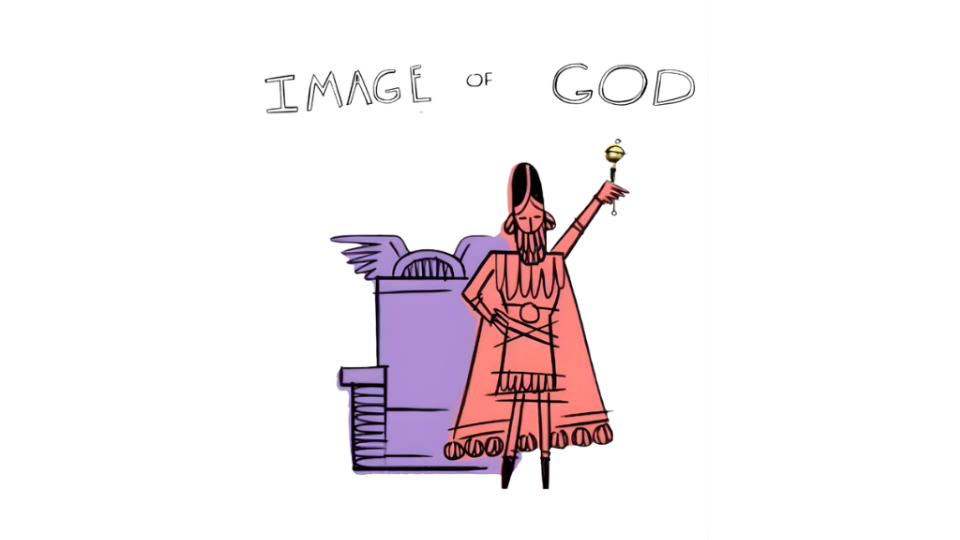
Every person is created in the image of God. God made humans to reflect his character and partner with him in bringing goodness into the world. The Bible shows us that Jesus is the perfect image of God and he can restore our hearts so we can reflect God in our daily lives.
Summary
In our first week we explored what it means for every human to be created in the image of God. Genesis teaches that God made people to reflect His character by bringing life, beauty, order, and goodness into the world. This connects directly to our earlier weeks on righteousness and justice where we saw that God is restoring all things and invites us to partner with Him in His work. Because every person is made in God’s image, we treat others with dignity, compassion, and care, and we look for ways to help people flourish in our homes, schools, and neighborhoods. Through Jesus, we are transformed and are being transformed to become more like Him so we can grow as His image bearers and display His character for the world to see. In Jesus, we are God’s sons and daughters who reveal His heart to a watching world. Our goal this week was for students to understand their identity as image bearers, their role in God’s healing mission, and the beautiful responsibility of bringing life, goodness, and flourishing to others every day.
What We Taught
• God created every human with incredible value
• Humans are God’s living images in the world
• God invited us to rule creation with him by helping life flourish
• Humans often choose selfishness which breaks the image
• We need God to heal what is broken in us
Questions Parents Can Ask
- What does it mean that you are made in the image of God
- How would your school look different if every student treated others as God’s image
- What is one place where you see people using their influence to help something grow or flourish
- Where do you see people using influence in selfish or hurtful ways
- What part of being God’s image feels the hardest for you
At Home Activities
• Family Garden Moment
Plant a small herb or flower together. Talk about how ruling like God includes caring for creation and helping things grow.
• Honor Someone Challenge
Ask your student to name one person who is difficult to love. Pray together for that person and talk about how God still made them in his image.
• Reflect Together
Read Genesis 1:26 - 28 together as a family. Invite each person to share one thing that stands out.
Further Reading + Viewing for Families
• Psalm 8
• Genesis 2:15
• Ephesians 2:10
• Bible Project video: Image of God


Copyright 2026 Gulf Coast Community Church